Recovering the three planets of L 98-59 with gaussia-search
A real run over five TESS sectors: three BLS peaks that line up with the three known transiting planets, why planet d comes out shallow, and why 1 thread and 20 threads give the same hash.
Why a known system first
Before a volunteer search can claim anything new, it has to find what is already known. L 98-59 (TIC 307210830) is a good test: a nearby M dwarf, 10.62 pc away, with Tmag 9.412 and a radius of 0.3142 R☉ in TIC v8.2[4], and three known transiting planets, catalogued as TOI-175 on ExoFOP[5]. The planets are small and their transits are shallow, between about 590 and 1,490 ppm in the catalog, so a search that gets them right is doing real work.
This post walks through one real run of gaussia-search v0.9.2, the search step of a Gaussia node, over five TESS sectors of that star. Everything below comes from the result file in the repo [2] or the README [1]. It is a recovery of known planets, not a discovery.
The run
The tool lists the star’s SPOC 2-minute light curves through MAST’s public API, downloads them over plain HTTPS and caches them. It drops flagged cadences, normalises each sector, detrends with a 1-day sliding median, clips upward outliers above 4σ (dips are never clipped), stitches the sectors and runs astropy’s Box Least Squares over a log-uniform period grid from 0.5 to 20 days with 8 box durations. After each peak it masks that signal’s transits and searches again, three times by default.
README · real run
$ uv run gaussia-search tic 307210830 --sectors 61-65 --json examples/l98-59-s61-65.jsonsector 61: cached tess2023018032328-s0061-0000000307210830-0250-s...sector 65: cached tess2023124020739-s0065-0000000307210830-0259-spoints 86979 baseline 132.66 d noise 788 ppm periods searched 36703#1 P=3.69050 d t0=2965.3421 dur=0.96 h depth=1687 ppm SNR=64.6 SDE=41.0 transits=32#2 P=2.25301 d t0=2965.8861 dur=0.96 h depth=583 ppm SNR=29.0 SDE=30.8 transits=56#3 P=7.45075 d t0=2964.6501 dur=0.96 h depth=883 ppm SNR=24.0 SDE=27.8 transits=16sha256:905cb9806da91f68403c2c0bae716033a85928013836826980bfee3c08acc38486,979 cadences survive cleaning across sectors 61 to 65, a 132.66-day baseline with 788 ppm of scatter. The grid for that baseline has 36,703 periods with a log step of 1.005e-4, spaced so a transit drifts by at most a third of the shortest box across the baseline [1].
Three peaks, three planets
The three peaks line up with the three known transiting planets. The catalog values are the NASA Exoplanet Archive default solutions, from Cadieux et al. 2025 [6], as listed in the README [1].
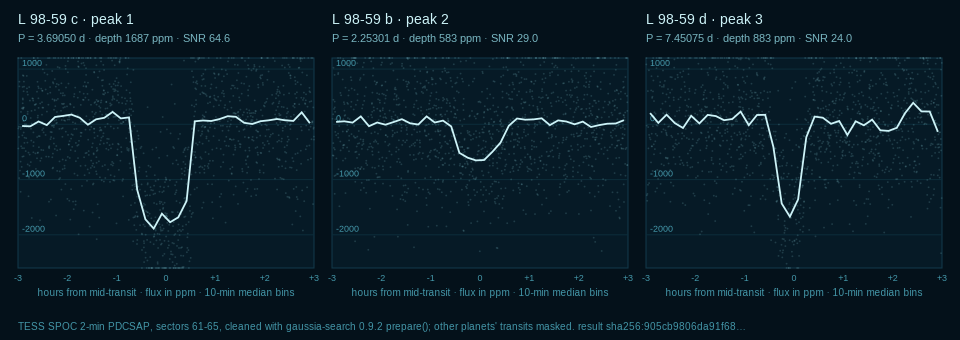
inputs), cleaned with the tool’s own pipeline, folded at each peak’s period and t0, with the other two planets’ transits masked. Dots are 10-minute median bins within ±3 h of mid-transit.Why planet d comes out shallow
Peak 3 has the right period but only 883 ppm of depth against a catalog 1445 ppm. The cause is the box. BLS fits a rectangular dip of a fixed duration, and the shortest duration on this grid is 0.04 days, or 0.96 hours (the durations_days list in the result starts at 0.04). L 98-59 d’s transit lasts about 0.84 hours[1]. A 0.96-hour box laid over a 0.84-hour dip averages in some out-of-transit flux, so the fitted depth is diluted.
All three peaks came back at that shortest duration. The README lists this as a known limit, along with a second one: on synthetic data, depth from a 1-day running median plus a box fit is roughly 10% low for a 3-hour transit [1]. Peak 1 comes out deeper than its catalog value instead (1687 vs 1486 ppm); we have not looked into why, so this post does not offer a reason. A BLS depth is a detection statistic, not a planet radius.
Vetting numbers
Each peak carries three standard binary checks. They flag; they do not decide. The thresholds are in the result’s config: vet_sigma 3.0 for odd/even and secondary, single_event_fraction 0.8.
Peak 2’s odd/even difference, 2.73σ, is the closest to the 3σ line. Odd and even depths that differ a lot are a sign of an eclipsing binary at twice the period; here none of the three crosses the threshold. A transit-shape test is in progress.
1 thread or 20, same hash
Gaussia is designed to pay a job only when two nodes, working blind, produce the same result hash. That only works if two honest machines get byte-identical output, so the tool defines its output down to the byte and hashes everything that can change it: every input file’s sha256, every pipeline parameter, and the tool versions (here gaussia_search 0.9.2, Python 3.12.13, numpy 2.5.4, astropy 8.0.2) [2].
Speed must not change the answer. Since v0.6.0 the period grid is split into chunks that run on threads; astropy’s BLS core releases the GIL and periods are independent. On this exact job the CHANGELOG records 42.7 s with one worker and 9.2 s with 20 threads, with the same result_hash [3], on the dev machine (Intel i7-12700H). The thread count is a run option and is never hashed.
Check it yourself
$ uv run gaussia-search hash examples/l98-59-s61-65.jsonok: matches result_hash in fileWe re-ran the search from the cached files on 2026-11-27 while writing this post and got sha256:905cb980…c08acc384 again. Every release changes the hash on purpose, because the tool version is part of it, so two nodes on one job must run the same release.
What's in progress
- A catalog filter inside the search. These three peaks are known planets and nothing in gaussia-search removes them. The separate cross-match tool in gaussia-mcp can check a signal, but it is not wired into a node.
- GPU BLS. The search runs on the CPU (threaded) today.
- A transit-shape test, and durations shorter than 0.96 h on the grid.
- The job coordinator, two-node matching network, review page, contracts and USDG payouts.
- Byte equality is tested on x86-64 Linux only.
Sources
- gaussia-search README: real run, catalog table, honest limits
- examples/l98-59-s61-65.json: the full result, inputs and vetting
- gaussia-search CHANGELOG, v0.6.0: thread timing
- gaussia-mcp README: star_info output for TIC 307210830 (MAST TIC v8.2)
- ExoFOP: TIC 307210830 (TOI-175)
- NASA Exoplanet Archive: L 98-59 overview (default solutions, Cadieux et al. 2025)